


“How Can We Market Peace?” – Philip Kotler
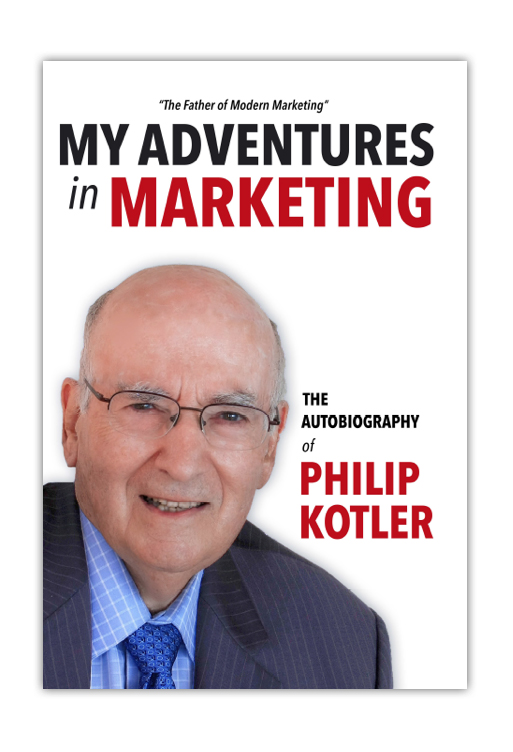 PHILIP KOTLER is known around the world as the “father of modern marketing.” For over 50 years he has taught at the Kellogg School of Management, Northwestern University, Evanston, Illinois. Kotler’s book “Marketing Management” is the most widely used textbook in marketing around the world. His autobiography, My Adventures in Marketing, tells his story – how a Ph.D. economist from M.I.T. became the world’s leading marketing authority. The following is an excerpt.
Here is a plea for peace we would do well to heed (make sure the sound is “on”):
Watching this video takes me back to a dinner in Jeddah, Saudi Arabia, in October 2010. At the dinner, the young son of a prominent Saudi Arabian family took me aside and posed a question. “Dr. Kotler, you have marketed many products and ideas. You have run many marketing campaigns for causes. You are well-known for your work in social marketing and social responsibility. I wonder why you have not run a marketing campaign to bring more peace into the world. I hope that you will do that next.”
Why don’t we have a real Peace Movement in the world? We know that there are many peace groups trying to carry on the cause of peace. Every year the Nobel Foundation in Oslo, Norway awards a Peace prize to an outstanding individual whose life and actions serve as a heroic message about peace. Past winners include Barack Obama, Al Gore, Nelson Mandela, and Muhammad Yunus.
Another group is the Oslo Business and Peace Foundation. On May 6, 2015, I gave a talk on how the “sustainability” movement could contribute to a more peaceful world. Over 1,000 persons attend their convention each year.
At the October 2014 World Marketing Summit in Tokyo, I was visited by Governor Yuzaki, the governor of Hiroshima prefecture who invited me to help organize a Peace conference in Hiroshima that would take place in October 2016. The Hiroshima World Peace Conference finally took place on October 14-15, 2016. Governor Yuzaki gave opening remarks and I gave the keynote address. Several sessions were developed with experts speaking at each session.
Here are the topics:
- Session 1: Disarmament Status and What Worked
- Session 2: How NGO’s and Government Use Marketingfor Peace Advocacy
- Session 3: How MarketingTools should be Used for Peace-building
- Session 4: Businesses that Build Soft Power and Contribute to Peace
- Session 5: The Young Global Leaders of the World Economic Forum
- Session 6: Business’ Peace-building Work for the Poor
- Session 7: Hiroshima as Global Peace Hub
The fact is that there are dozens of organizations working for peace. The United Nations itself was set up to build a peaceful world and put an end to future wars. One could go to Wikipedia and look up the category called “Peace Organizations” and find a very long list, including such organizations as American Peace Society, Asia-Pacific Peace Research Association, Bertrand Russel Peace Foundation, Buddhist Peace Fellowship, Catholic Association for International Peace, Economists for Peace and Security, German Peace Society, Global Peace Institute for Women, International Peace Institute, and Nonviolence International.
One of the problems preventing a serious and impactful peace movement is exactly the number of separate organizations striving to promote peace. One hopes that these organizations will talk to each other, form larger coalitions, and combine their resources and messages to achieve a strong media presence and impact.
But marketing peace calls for more than a pointed and continuous communication campaign.
It calls for a fundamental change in the distribution of the world’s assets and resources! Peace won’t come as long as only two billion of the world’s current population live middle class lives and five billion struggle to avoid hunger and disease. Peace won’t come when so much of the world’s wealth, capital and income are in the hands of so few families scattered around the globe. Leaders must understand how rising income inequality causes unrest and conflict. Can it be fixed?
Peace won’t come as long as there are so many different belief and value systems that clash with each other. Each major religion is a belief system. Each ethnic community has developed its own belief system. Each economic class has fashioned a different belief system. Every group lives to defend its own belief system and many strive to impose its belief system on others.
The deep question is: how can two groups with competing beliefs and values and resources have a dialogue that would move them toward recognizing their common humanity?
How can the Democrats and Republicans work together to produce legislation that makes more Americans better off? How can the Palestinians and Israelis find a solution that is a win-win for both?
Does conflict resolution theory contain enough insights and processes to help bring conflicting groups into peaceful settlements?
I invite more of us to grapple with these challenges.
Philip Kotler‘s My Adventures in Marketing was published in June, 2017. The book covers: new ideas on marketing science and practice – views on the future of marketing and retailing – views on place marketing, person marketing, idea and cause marketing – encounters with museums, art collectors, and the performing arts – concerns about the growing threats to Capitalism and Democracy – proposals for reducing poverty, corruption and income inequality – international adventures in Italy, Sweden, Japan, India, Indonesia, Thailand, Brazil and Mexico – life in Chicago, Chautauqua and Longboat Key, Fl. – meeting Nancy and raising their wonderful children and grandchildren – adventures at the University of Chicago, M.I.T., Harvard and Northwestern. Copies of the limited edition are available for sale on Amazon. Sign up for his newsletter >>


